The Fire Next Time

The phenomenon of catastrophic fires in urban centres feels like a metaphor for wider society. Despite much love and affection for place and people, our cities are uncared for by those in power. Poorly regulated, foreign-owned and commodified, our cities are where we live, but they are not for us. And yes, when a disaster strikes our emergency services are brave and competent, and surrounded by goodwill for it.
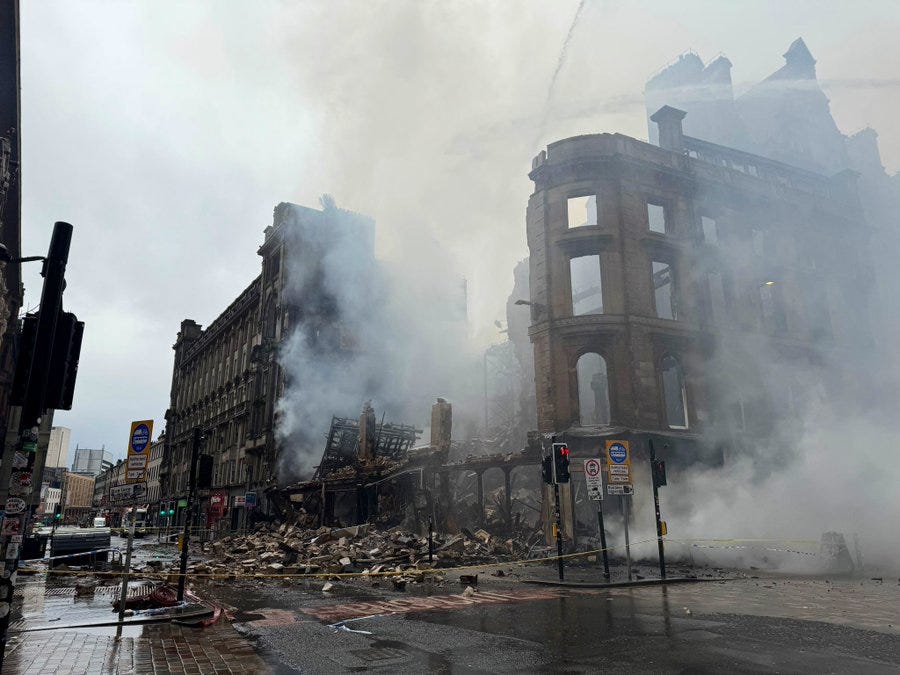
But a society that is literally always firefighting is one that doesn’t have time to plan, to breath, to imagine. We are staggering from crisis to crisis and our cities reflect this.
Writing in The Drouth Murdo Macdonald noted: “While the first fire was still raging at Glasgow School of Art a friend wrote that it felt more like the loss of a well-loved personality than a building on fire.” Similar emotions were being shared as a collective moment of grief engulfed everyone’s feeds just as the fire engulfed Glasgow Central Station.
Glasgow maybe has a special relationship to and pride in its built environment. These places are not just where you had significant shared moments in your life but they also represent a grander past. 150 years ago we were building municipal buildings of style and substance - now - as the Reddit group chat goes we’re building ‘Student Flats’. This isn’t some conservative defence of ancient architecture, but just noticing that the buildings people love are usually built for everyone, or for a common purpose.
The renovation and re-opening of the People’s Palace has been ‘delayed indefinitely’, Edinburgh has been reduced to a theme-park for tourists and the housing crisis of both catastrophic homelessness and lack of affordable homes continues unabated because the political class are both implicated in landlordism and incapable of providing long-term solutions to deep-seated problems.
Thankfully, no one seems to have been hurt, and Central Station has miraculously survived. But the problem of city centres that are hollowed-out and abandoned will remain until cities themselves are seen as places of resistance, and until we reclaim citizenship in them.
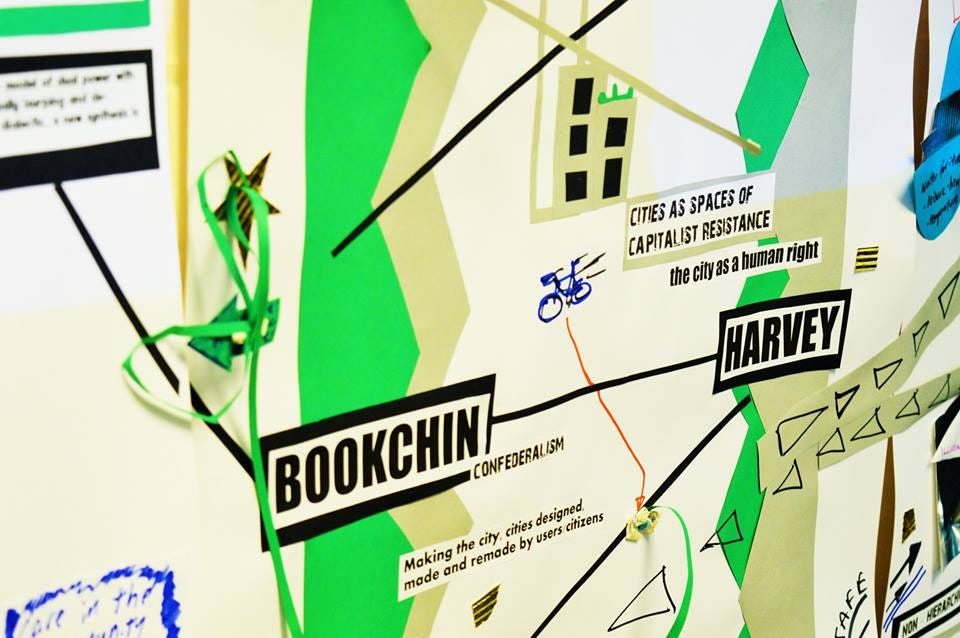
The danger is that the tragic events such as the fire in Glasgow city-centre are seized on by the far-right to perpetuate their narrative of inevitable decline. The endless attacks on the contemporary city - be it Trump about LA or Farage about London or Offord about Glasgow - reflect the fact that they represent everything they hate: collectivism and diversity. As Andy Beckett wrote (‘From LA to Paris, the populist right hates cities – and it’s fuelled by a sense of bitter defeat’): “Cities are where the future often starts, and populism is often about holding on to the past.”
“While conservative populism reveres, or says it reveres, the nation state, the countryside, community, social continuity and the traditional family, cities are often places of more fluid loyalties. While populism presents politics as a simple battle between “the people” and their enemies, cities, by gathering so many interest groups in one place, show that politics is in fact a more complex process: involving competition but also cooperation, contests over space and resources, and many social forces, including class, gender, sexuality, local pride and race.”
The discussion needs to be deepened beyond fire safety and management and into the wider questions of who the city is for. We live in a world on fire, and the crisis in our cities is only a reflection of that. Maybe it’s possible to gather the sadness and rage that such incidents evoke and turn them into movements for real change.
Profound and perceptive commentary Mike. You're often necessarily abstract but always in touch with our emotional and social reality. Thank you.
Paradoxically, the fire has brought people together in a collective community of grief and revulsion at the far right comments of anonymous bots mainly from England and further afield. The delicious yet completely unfounded rumour that a certain orange team flare started the blaze has been absolute rage bait for these people.