Early Days
for Gray Day 2026

In an essay about spending some time in the Alasdair Gray Archive [Work as if you were in the Early Days of a Creative Republic], Christopher Silver notes:
“One of the curious things about Gray is that — despite being a long-term advocate of Scottish independence and the author a popular book on the subject — he never really had that much to say about it. I don’t think it particularly interested him as a debate, it was just a series of self-evident truths that could be set alongside bigger, cosmic, causes. The key word here is perspective: as a dogged republican, politics for Gray begins with as much power as close to home as possible, the other layers should be shaped based on how much humanity can be injected into them at each stage.”
This is both true and not true.
What Scott Hames called the ‘unofficial credo of Scottish cultural nationalism’, Gray’s phrase ‘work as if you were living in the early days of a better nation’, acts as a rallying cry and signifier for a wider movement. It’s notion of ‘early days’ carries a romantic lightness to it, but also an idea of trajectory. But it’s the idea of ‘work’, a value and attribute hard-coded into Scotland’s sense of itself that gives the phrase its power.
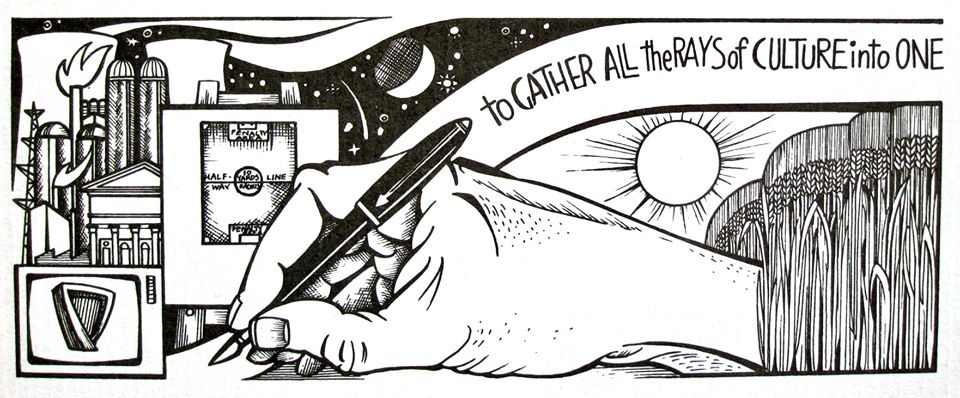
But there’s another saying from Gray that often gets obscured: ‘to gather all the rays of culture into one’ which adorns the Edinburgh Review but is also used by the Gray Archive. It’s a visual statement of Generalism, of which Gray was a proud defender (and embodiment).
The outstretched hand comes out of the land itself and the sun shines under ‘the rays’. Gray’s familiar iconography is in place: the Celtic Harp within Logie Baird’s television; the football pitch up on the canvas; the classical architecture, a nod to Alexander Greek Thomson; and the chimneys of industry giving way to the stars and cosmos.
Silver is right to point out that Gray had little to say about independence other than it was a given. But he influenced Scottish culture with that assumption and with insight in both the pre-devolution era and the pre-referendum one.
When Kevin Williamson and I launched Bella Caledonia nearly twenty years ago we were inspired by, and collaborated with Gray. One of the things we loved (and love) about him was his complexity. I wrote after his death about this interaction:
“For us Gray’s vision of Scotland and his spirit of generalism were an inspiration, as was his weird concoction of civics, futurism, socialism and aspiration for a better Scotland. Nationalism (particularly Scottish Nationalism?) was imbued with an old-world aesthetic, and socialism was dogged by a commitment to ‘struggle’ and the industrial past that seemed incongruous with the 21 C.”
“Gray’s world was spectacular, vivid, sexual, magnificent. It was a world where Scotland was something and could be anything.”
This is important and goes against the grain of consigning him only to a slogan around a Calvinist sense of work.
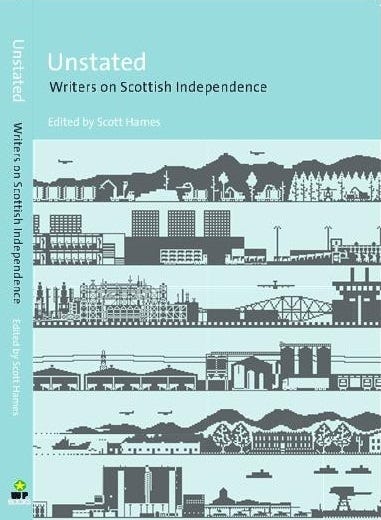
It is important also, not to consign him to being seen only as an eccentric, a maverick, or a national treasure. To do so is to belittle him. When Gray contributed to the collection of essays ‘Unstated’ published in 2012, he was widely attacked.
His essay on “settlers and colonists” was savaged. In response, Isobel Lindsay wrote for Bella ‘The Sociology of the National Cringe’:
“Liz Lochhead and Alasdair Gray have been subject to predictable abuse for raising the question of the number of Scots in leadership positions in the arts. Others have met the same response for questioning the social class background of elites and the gender and ethnicity distribution of those in top jobs. It is not only legitimate to raise these questions, it is also irresponsible to avoid them because they are socially significant.”
This double-edge, between work and playfulness, between humour and hardness was everywhere in Gray’s work.
There’s the famous quote from Lanark, that is worth repeating here:
"Glasgow is a magnificent city," said McAlpin. "Why do we hardly ever notice that?" "Because nobody imagines living here," said Thaw... "Think of Florence, Paris, London, New York. Nobody visiting them for the first time is a stranger because he's already visited them in paintings, novels, history books and films. But if a city hasn't been used by an artist, not even the inhabitants live there imaginatively."
It’s a quote that’s worthy of its repetition, but I think we can think of it as speaking about wider Scotland as well as Glasgow. When you watch our tv and film industries often smothered and unable to give real representation, this dialogue hits home.
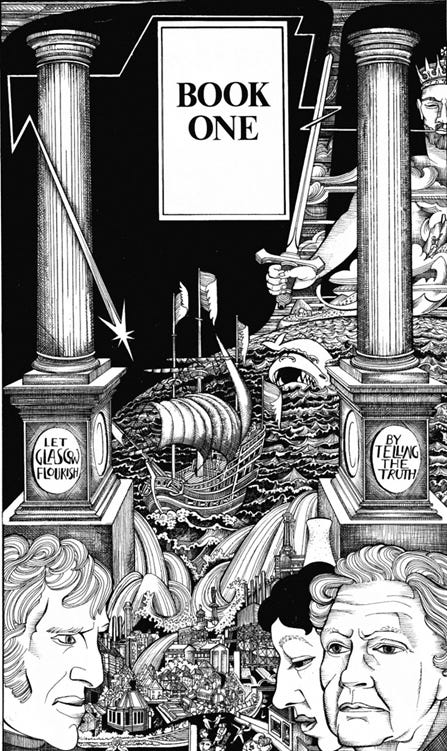
The writer Janice Galloway found inspiration in Lanark, and in the idea that the characters were ‘striving’ for something else.
She has written:
“To a reader in a country where resignation is a national pastime, a country where the standard childhood training lists "showing off" as the worst sin of all, a country whose church, family and education systems used once to ring with the hurled accusation, "Who do you think you are - someone special?", this encouragement to strive nonetheless was powerful stuff. And how much, how very much, it touched the heart.”
This idea of ‘strive’ / ‘don’t strive’ takes us back to 2014.
In his essay Culloden via Tesco Scott Hames reminds us that at the launch of the ‘No’ campaign Alistair Darling warned against ‘going on a journey with an uncertain destination’. Some people immediately suggested that sounded like a great idea.
Hames pointed out that if the destination is known in advance, it is not a journey at all, and ponders whether ‘going nowhere’ is the essential message of ‘Better Together’.
This notion of a wildly-imaginative transgressive writer in Gray is transposed to his political thinking - and aspirations for Scotland. This idea of the playful/obsessive, radical/absurdist is played out in Gray’s gothic masterpiece Poor Things (1992), which has lain in the shadow of Lanark for too long, perhaps because Lanark has been described as ‘unfilmable’.
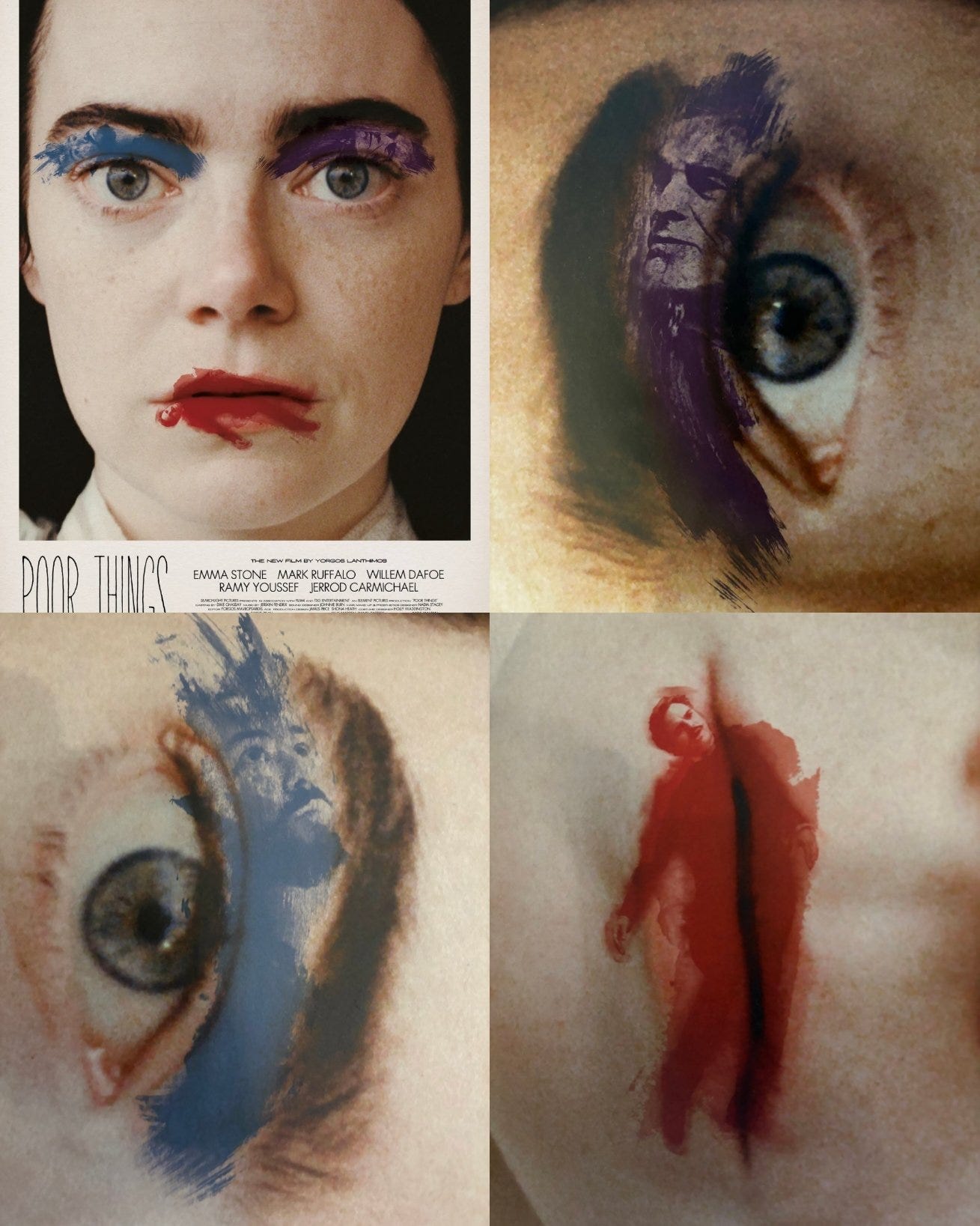
It’s perhaps testimony to Gray’s genius as much as Yorgos Lanthimos that the film was such a success. But, again, among the visual feast we shouldn’t lose track of Gray’s political message.
If we take Bella Baxter’s parents as Mary Wollstonecraft author of A Vindication of the Rights of Woman, one of the earliest works of feminist philosophy, and William Godwin, the godfather of modern anarchism we see a different insight into both the film and the book that inspired it.
The legacy Alasdair Gray leaves us is rich and deep and more political and multi-dimensional than we realise.
June Stewart reminded me that the phrase “work as if you were living in the early days of a better nation” was originally penned by Canadian poet and author Dennis Lee and appears in his 1972 poem Civil Elegies.